
02 Dec 2025 | Jordan Wilson & Nicholas Thomas
In conversation with the curators of "Fault Lines" (Part 4/4): Jordan Wilson
The exhibition Fault Lines: Imagining Indigenous Futures for Colonial Collections, supported by this ERC Starting Grant, opened in December 2024 and will run until December 2025 at the Museum of Archaeology and Anthropology (MAA), Cambridge. A collective, convened by Noelle M.K.Y. Kahanu with Leah-Lui Chivizhe, Taloi Havini and Jordan Wilson, curated this exhibition. In this blog series, they outline the project, through responses to questions prepared by Nicholas Thomas, director of MAA. All parts will appear jointly in a publication that is currently in progress. Read the conversations here in advance.
Jordan Wilson
Could you introduce yourself and say something about the place and context you are working from? What are the core issues or priorities that shape your work as an artist / curator / activist / researcher and that you have brought to this particular project?
My name is Jordan Wilson, I am a curator, writer and PhD candidate in Anthropology. I belong to the Musqueam First Nation; our traditional, ancestral and unceded territory encompasses much of the region that surrounds what is currently known as Vancouver, British Columbia, Canada. Our main village and reserve are located at the mouth of the Fraser River, and we have many ancestral villages and sites of importance along the river and throughout what is now the city landscape. While I am studying anthropology, I have a background in Indigenous Studies, which informs the work I do as a curator. A common thread throughout my work is considering and facilitating the ways contemporary Indigenous community members are engaging with the material legacies of anthropological collecting. In North America, Europe and the United Kingdom, historical collections were formed in a time of great duress and broader dispossession of Indigenous peoples. Indeed, these collections and institutions were created for both a public and scholarly audience that did not include the descendants of our ancestors; we were thought to be disappearing. So, I am interested in how our people are negotiating these spaces and collections, for our own needs and desires, recuperating and strengthening knowledge and worldviews.
More specifically, I am interested in the materials categorized as ‘Coast Salish’–the broader cultural group of which Musqueam is a part–which have received less scholarly and art historical attention, and, given the history of collecting in my part of the world, tend to be further afield, in museums on the Eastern Seaboard of the United States and in the UK. I was drawn to this project to begin learning and thinking about these collections in greater depth. I am interested in how little is known about many of these historical objects, in terms of their specific histories, their individual makers and owners, as well as their particular imageries and forms. What information has yet to reveal itself from these belongings, which at times feel like a direct conduit to our ancestors and the lives they lived?
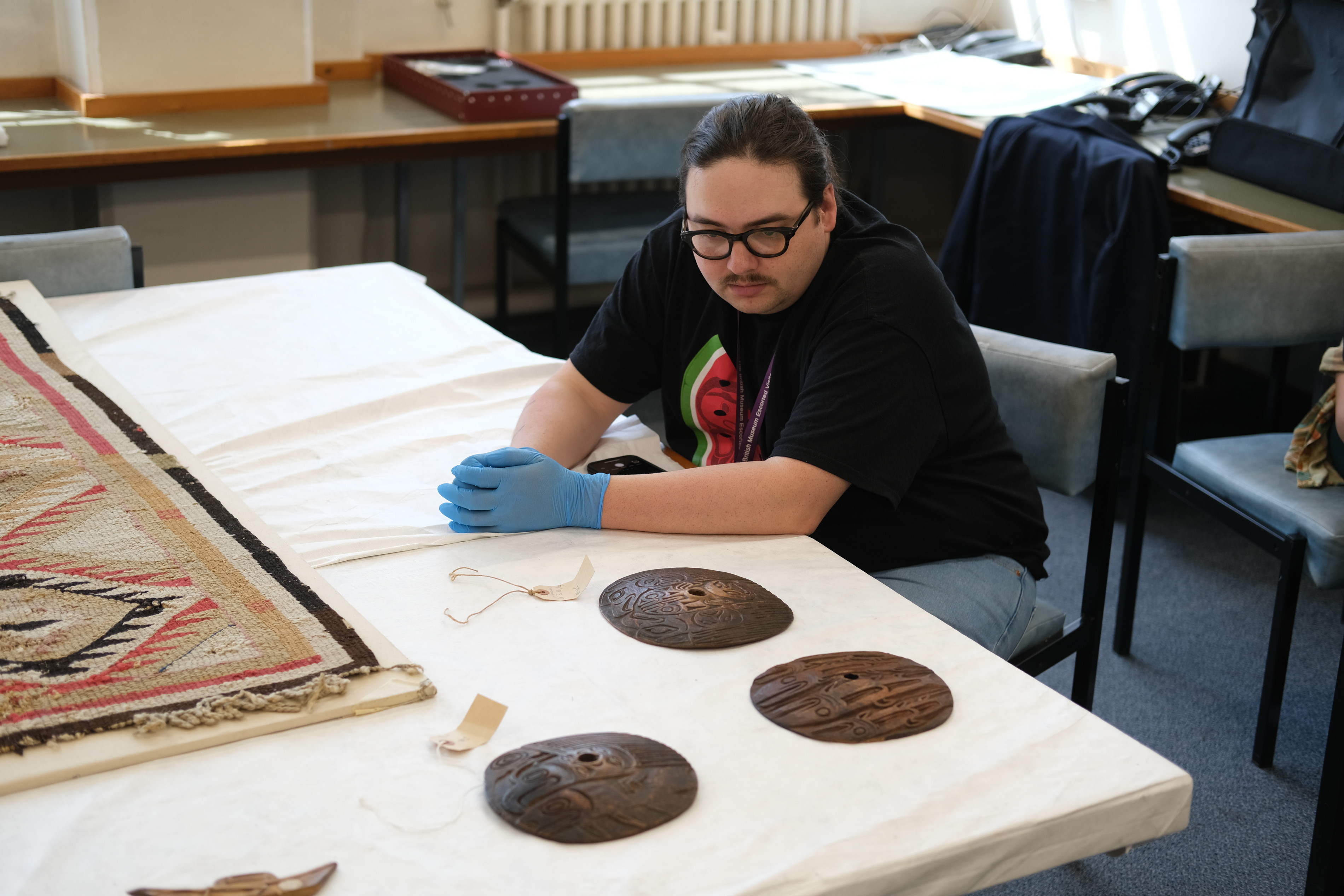 Eliot White-Hill, Kwulasultun (Snuneymuxw First Nation) with Coast Salish spindle whorls and Salish robe, British Museum, May 2024. Photo: Jordan Wilson.
Fault Lines addresses the future of colonial-era collections in museums such as the Museum of Archaeology and Anthropology. Could you give us a sense of your engagement with museum collections, and particularly with museum collections such as those in Europe, that are now and have been for decades, if not longer, distant from communities of origin? What in other words are your starting points for imagining the future?
My formative experiences of engaging with historical collections is rooted at the UBC Museum of Anthropology (MOA). Most recently, I co-authored Where the Power Is: Indigenous Perspectives on Northwest Coast Art (2021), which brings together contemporary Indigenous knowledge holders with historical Northwest Coast art and belongings at the site of the museum. It was a privilege to work on that project, which featured the perspectives of over 80 community members. I think the biggest takeaways from that project is how important and valuable direct physical engagement can be, but also the complexities that communities are dealing with in terms of the legacies of these collections. Personally, I’ve also been fortunate to visit collections in major institutions across North America–to spend time with historical Musqueam and Coast Salish materials–at the American Museum of Natural History, the Smithsonian, the Canadian Museum of History, the Peabody Museum at Harvard, and others. Those experiences demonstrated to me that there is still so much research yet to be done, but also the sheer quantity of ancestral objects that are so far from their homes.
Fault Lines afforded the special opportunity to visit materials dispersed across the UK. I wanted to include other younger Coast Salish people who are interested and engaged with historical collections, as these types of opportunities are seldom. The inaccessibility of these ancestral materials is indeed one of my primary concerns when I think about historical museum collections in Europe and the UK; how can they be made more accessible? What can we learn from them? If repatriation to specific home communities is impossible, given the lack of provenance of the majority of historical objects, how could these be brought closer to their homes? How can UK institutions support hands-on engagement and learning? How can we increase awareness and familiarity with these collections in our home communities, particularly among emerging artists?
When the opportunity arose, what artefacts and/or images from the historic collections (at MAA or otherwise in the UK) were you concerned to foreground? What particular significance does the material have?
Given the vast amount of Coast Salish material in the UK, which is seldom exhibited, selecting a small group was daunting, because ultimately, it is all of equal significance. That said, I wanted to select a group of belongings that resonated with me, because in part, the intention was to convey a sense of pride and care for the things that exist in collections. I was informed by a few desires. I wanted to include a diverse range of object types, to convey the wealth of traditions from our part of the world. I knew I wanted to include belongings that came from the lower Fraser River, which is where Atheana Picha and I are from, and from the Snuneymuxw (Nanaimo) area, where Eliot White-Hill is from. Our process was a bit backward, as given the circumstances, I had to make selections well before we were able to travel as a group to the UK and visit collections in person. I think if we had visited first, it would have been a slightly different selection. I also wanted to exhibit belongings with very little or no provenance, to point to the broader issues and legacies we are grappling with.
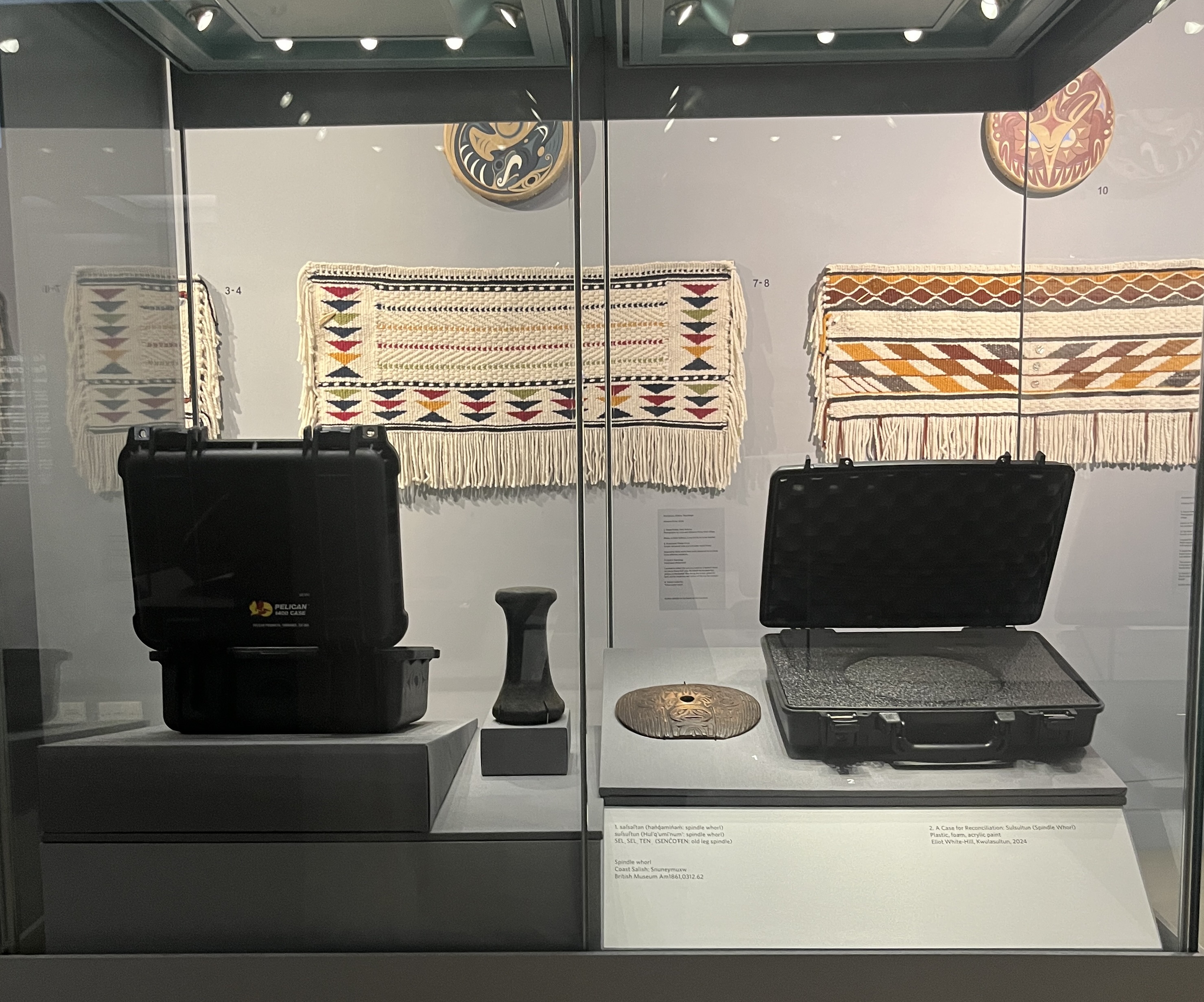 Foregrounded is Eliot White-Hill’s “A Case for Repatriation,” with the woven works of Atheana Picha (Kwantlen First Nation) appearing through the glass. Photo: Noelle Kahanu.
What approach did you take to contextualising and/or re-activating the material?
I knew from the outset that I wanted the invited artists to respond in whatever way they chose–I knew that our group visit to the MAA, the British Museum and the Pitt Rivers Museum would be both inspiring and difficult. I was curious as to how these very talented artists would respond to the entire experience, of both the direct engagement with the ancestral material as well as the context of these very significant historical institutions and their legacies.
The art they produced do very different work. Atheana felt pulled towards weaving blankets, carving blanket pins, and painting drums, inspired by the belongings that we spent time with, but not making direct recreations of anything in particular. She wanted to include portraits of her mentors wearing and holding the pieces that she made, which, from my perspective, is an effective means of contextualizing her own practices, but also recontextualizing the historical material on display–these too were once worn, held, and used by real living people. Eliot was motivated by a questioning of the ancestral belongings’ current status as museum objects, and imagining the future possibilities of bringing these things home, and also questioning the ways in which Indigenous cultural objects are valued by academia, the art market, and institutions. His two travel cases are issuing a challenge to museums, in effect stating: we are ready to bring these home–how will you respond? Ultimately, both Atheana and Eliot’s works demonstrate a sense of care and deep respect for both the historical materials that are exhibited alongside them and those in storage.
In terms of my curatorial writing, I wanted to avoid an overly ethnographic or historical approach and instead focus on messaging about our distinctive relationships with our ancestors, ancestral belongings, and museums. Lastly, I wanted to incorporate as much of our respective Indigenous languages as possible in the object labels as a form of reconnecting and recontextualizing the works on display, even if the languages are incomprehensible to the majority of viewers.
What would you want visitors to take away from the exhibition?
Overall, I want visitors to ask the question: “Why are the cultural treasures of Indigenous peoples housed in foreign museums so far away from where they originated? Why, and how, did this come to be a normative thing?” While these objects have been in these various collections for well over a century, that is not their full story and might not be the end point of their journeys. I want to convey to visitors that these belongings are connected to living communities. I agree with Eliot, who, during one of our visits to collections, observed aloud, “What are these even doing here? They just don’t belong here.” While a lot of the material collected pre-dates the duress of settler colonialism and reflects the agency of our ancestors in early encounters, from his perspective, they would have so much more value to our communities if they were closer to home. We really value and care about these things; to us, they are more than museum objects, they are ancestral belongings and treasures.
In parallel to offering this critical perspective, I also wanted to provide just a glimpse into the richness of our cultural traditions and worldviews that still persist. Atheana’s works in particular demonstrate a sense of continuity from our ancestors to the present, in terms of their materiality. I always have a sense of awe when I am in the presence of the work of our ancestors–it makes me think about how they engaged with and saw the world, their skills and knowledge, the teachings they passed down to us–and I hope that visitors share a similar sense of appreciation.
References
McLennan, Bill, Jordan Wilson and Karen Duffek. 2021. Where the power is: Indigenous perspectives on Northwest Coast art. Vancouver: MOA (University of British Columbia).
Read the conversations with Noelle M.K.Y. Kahanu, Leah Lui-Chivizhe and Taloi Havini and learn more about the research project.